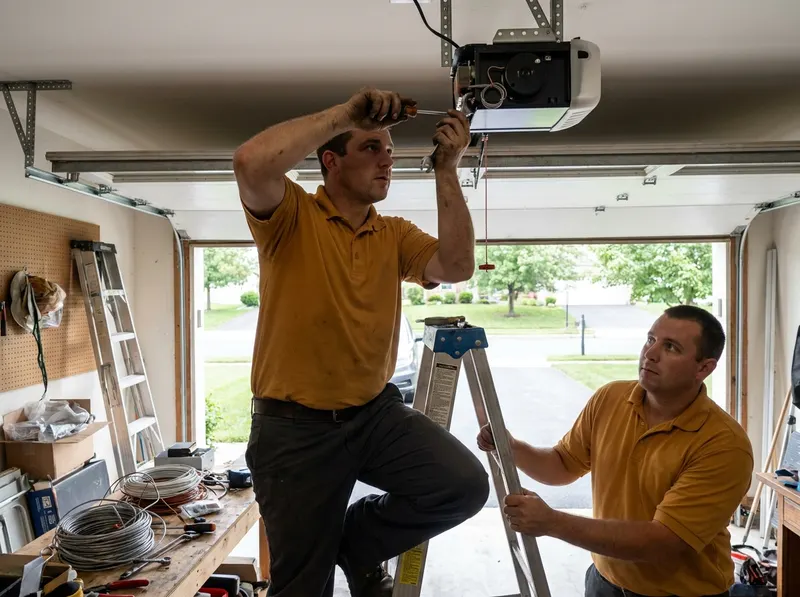
The fastest way to know whether you need opener work at all: pull the emergency release with the door fully closed and lift the door by hand. If it glides up and stays put around waist height, the springs and tracks are healthy and the fault is in the opener. If it feels like lifting a filing cabinet or slams back down, the problem is spring or cable tension and the opener is only the victim — running a motor against a door that won't balance is exactly what strips a nylon drive gear. That single test saves Lancaster homeowners from paying for the wrong repair, and it's the first thing we ask about on the phone.
Symptoms map to parts more predictably than people expect. A motor that hums or grinds but the door never moves is usually a stripped gear and sprocket in a chain-drive unit — a replaceable kit, not a dead opener. One loud click and then silence points at the capacitor or motor start circuit. Lights blinking with no movement, or a door that reverses a foot off the floor, is nearly always the safety sensors: knocked out of alignment by a bike or a mower, corroded from a wet slab, or blinded by low afternoon sun through a west-facing opening. Remotes that work at ten feet but not from the street usually mean a failing receiver board or a dying antenna wire, not a bad remote. Dead everything after a summer thunderstorm typically means a surge-damaged logic board, which is a common Lancaster County call in July and August.
Geography matters here more than it sounds. The alley-facing detached garages behind Cabbage Hill, SoWe, and the East Side often run a long low-voltage wall-button line and older wiring, so intermittent operation there is frequently a splice or a rubbed wire rather than the motor. In Chestnut Hill and Musser Park, older single-car garages tend to carry 1980s and 1990s chain drives — parts are still available for many of them, so repair usually wins. Attached garages under bedrooms in School Lane Hills, College Hill, Grandview Heights, and Rossmere are where noise complaints come from; a chain drive can be quieted with proper rail lubrication, tension, and isolation hardware, and when a unit truly is past saving, a belt drive is the sensible swap. Out toward Bausman and the township edges, unheated garages in January thicken the grease enough that a marginal capacitor finally quits on the first cold morning.
Our stance is repair before replace. If a gear kit, board, capacitor, sensor pair, or trolley brings a structurally sound opener back to reliable operation, that is what we recommend. We'll tell you plainly when it doesn't add up — a burned motor winding, a cracked housing, a discontinued board with no parts stream, or a unit predating modern photo-eye safety requirements. In those cases replacement is the honest answer and you'll hear the reasoning, not a sales pitch. Before we arrive: unplug the opener, and do not yank the emergency release while the door is stuck part-way open under tension — leave it, park the car outside, and we'll handle the release safely on site.
Every figure below is a ballpark based on typical Lancaster jobs. The exact price is confirmed on-site after diagnosis, in writing, before any repair begins — and the minimum for an opener repair visit is $300.